LED retrofit on existing masts: weight, wind load, structural checks
Existing masts can often continue to be used, but only after an inspection. LED floodlights can be heavier than the old luminaires, and structural documents are usually missing. The floodlighting guide from the football associations of Saxony, Saxony-Anhalt and Thuringia therefore generally considers a structural inspection necessary.
From Leon Weber, Key Account Manager Sport · As of:
Why structural checks matter in a retrofit
LED is not automatically lighter. According to the football associations' guide, the new floodlights can weigh more than the old ones, so the existing trusses may no longer be usable.
What matters is the total load on the mast: number of floodlights, weight, wind-exposed area and the cross-arm. Fewer floodlights can reduce the load. The city of Münster, for example, replaced around 350 old metal halide lamps with 225 LED floodlights.
Weight of the floodlights
The weight of the new floodlights is in the datasheet. For a comparison you also need the weight of the old luminaires and of the cross-arm.
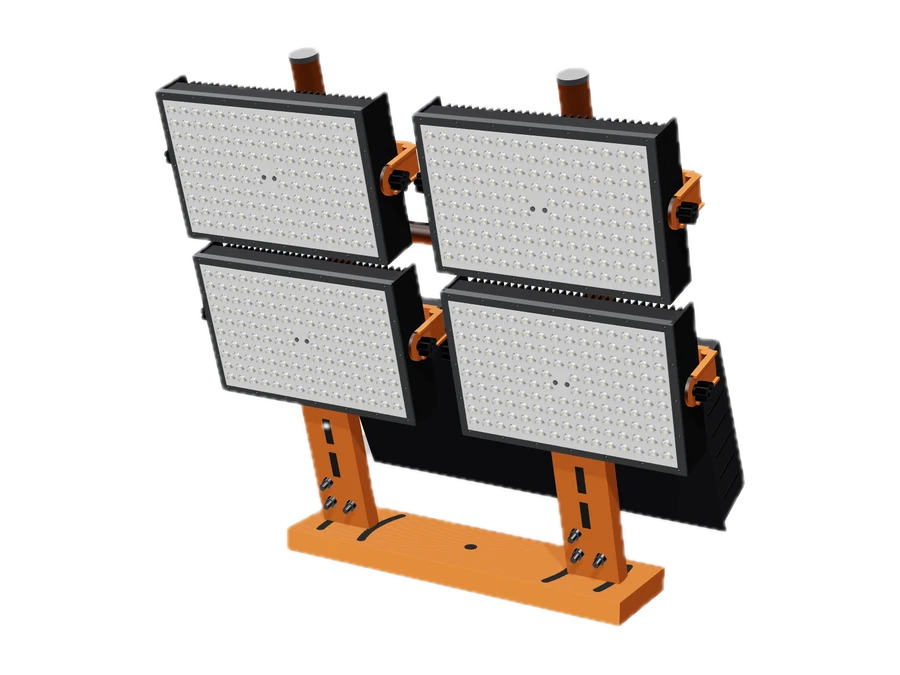
- STL963 (4 modules): 20 kg
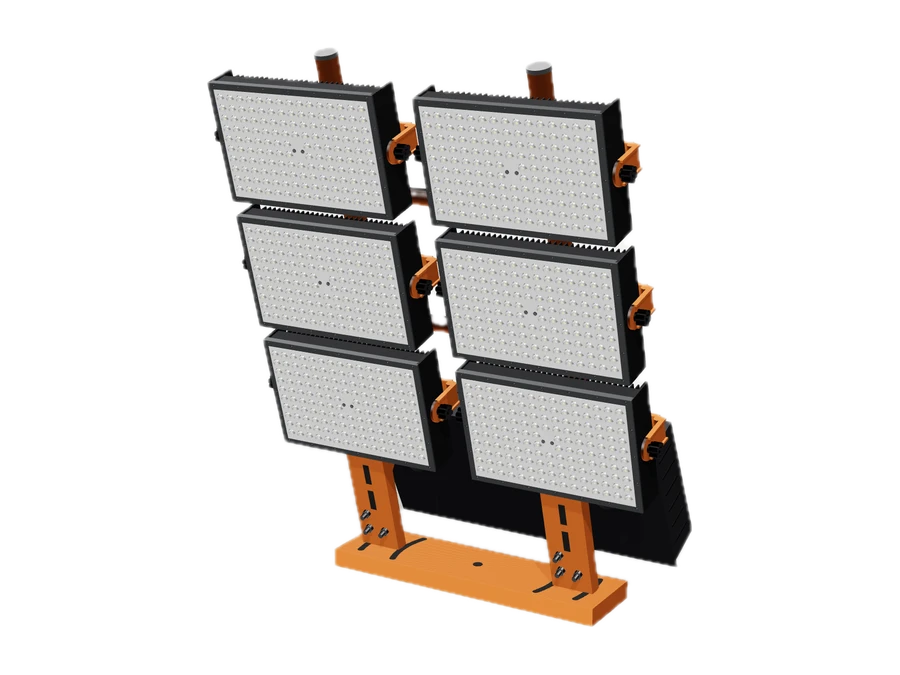
- STL1443 (6 modules): 27.5 kg
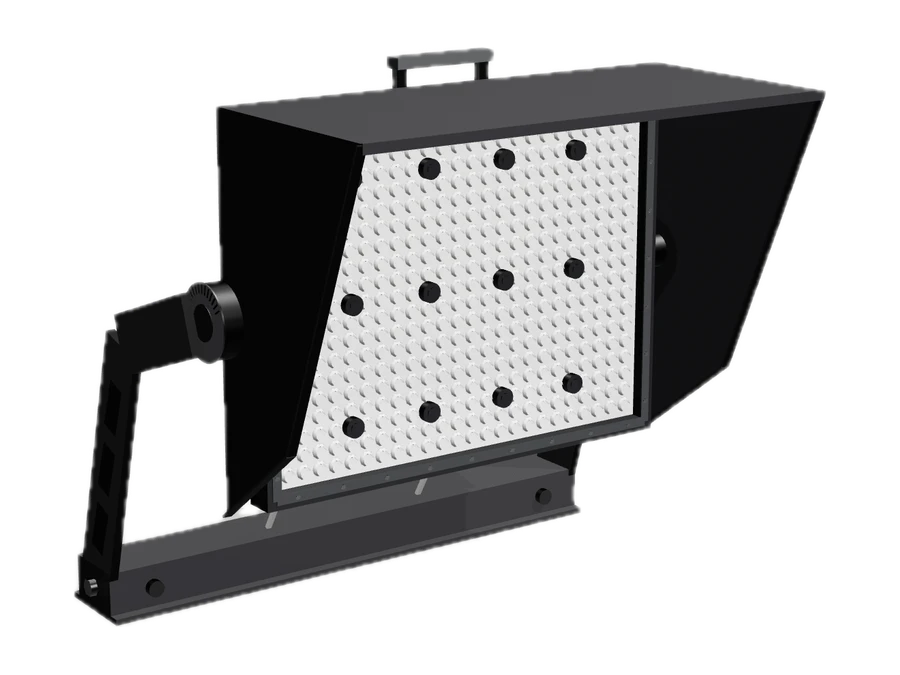
- STL1500: 28 kg with driver, 22 kg without
Wind and ice
Wind acts on the floodlights, cross-arms and mast. How strongly depends partly on the location: Germany is divided into wind zones under DIN EN 1991-1-4, and the Deutsches Institut für Bautechnik publishes the allocation by administrative boundary.
The association guide also mentions ice accretion: for the calculation, 3 cm is to be assumed on all parts exposed to the weather. In upland areas such as the Ore Mountains, the Harz and the Thuringian Forest it can be considerably more.
How a mast is tested
In a mast test procedure, the mast is loaded in four directions. This shows whether it absorbs the forces elastically or whether there are material or foundation defects. According to the association guide, timber masts are exposed to a depth of 60 cm and tapped.
The condition depends on the material. From inspections, the association guide gives these shares with no findings:
- Concrete: 93 %
- Steel: 88 %
- Timber: 62 %
According to the association guide, the usual inspection interval is 6 years, as long as the mast has not been modified or damaged. It calls noise barriers and ball-stop nets bolted or welded to the mast afterwards an impermissible modification that can lead to masts collapsing.
A practical example: Landsberg am Lech
The city of Landsberg am Lech converted its 1976 floodlighting system to LED and had all 11 masts checked beforehand for structural integrity and service life. The result: the system can be operated for around 15 more years, and one mast had to be replaced at short notice. Its foundation was kept and reused as a socket foundation.
There was also a practical reason for keeping the masts: replacing a mast would have damaged the newly renovated sports surfaces. The number of luminaire heads fell from 18 to 14.
Load-bearing does not mean suitable
Even a stable mast can be too low. According to the association guide, existing masts are often only 8 to 12 m high, which promotes glare and shadows. It recommends 16 m for training and 18 to 20 m for competition facilities. Whether the existing height is enough is shown by the lighting calculation using the data of the new floodlight.
Who is responsible?
Whoever owns the masts is responsible for safety. According to the specialist lawyer quoted in the association guide, a municipality remains liable even if the usage agreement transfers the masts to the club. With heritable building rights and masts erected by the club, it is the club. Clarify responsibility before placing the order, and in case of doubt take legal advice.
The enquirer is responsible for details provided remotely, such as mast height, condition and documents. We only check structural stability during an on-site visit.
We supply dimensions, weights and the lighting calculation for your masts. The structural stability verification is prepared by a structural engineer or a testing company.
Floodlights for the retrofit
- Series 12
STL963
Smaller installations and few masts: tennis, padel, training pitches.
- Colour temperature
- 3000 K, 4000 K, 5000 K
- Power
- 960 W
- Weight
- 20 kg
Datasheet as PDF (459 KB) - Series 12
STL1443
Larger pitches with few masts: football, hockey, athletics.
- Colour temperature
- 3000 K, 4000 K, 5000 K
- Power
- 1,440 W
- Weight
- 27.5 kg
Datasheet as PDF (436 KB) - Series 12
STL1500
High requirements from about 500 lx: competition, higher leagues, stadium.
- Colour temperature
- 3000 K, 4000 K, 5000 K
- Power
- 1,500 W
- Weight
- 28 kg
Datasheet as PDF (333 KB)
Frequently asked questions
Can old floodlight masts continue to be used?
Often yes, if the inspection confirms stability and the height is sufficient for the lighting calculation. The cross-arm must also fit.
Are LED floodlights lighter than old HQI floodlights?
Not necessarily. The association guide points out that LED floodlights can weigh more. What is compared is the total load on the mast, not the individual floodlight.
How often does a floodlight mast have to be inspected?
The football associations’ floodlighting guide states every 6 years if the mast has been neither modified nor damaged. According to the association guide, the electrical installation must be inspected by a qualified electrician at least every 4 years.
What happens if no structural documents exist any more?
According to the association guide, that is the normal case. A structural inspection is then required to verify stability.

Have existing masts checked
Tell us the mast height, number and sport. We calculate the light distribution and supply the data for the structural engineer.
Start enquiryTalk directly


Sources
- Football associations of Saxony, Saxony-Anhalt, Thuringia: Lighting of football pitches and training areas (2019), pp. 4–6, 10, 12, 17, 19, 23
- City of Landsberg am Lech: project information on floodlight system refurbishment
- City of Münster: conversion to LED floodlighting, press release of 26 May 2025
- DIBt: Technical building regulations, allocation of wind zones by administrative boundary
- TRiALED: Datasheets Series 12 and STL1500 (weights)