LED lighting for indoor hockey
Indoor hockey is played with a small, fast ball that changes direction quickly. DIN EN 12193 therefore already specifies 300 lx with a uniformity of 0.7 for school sport and training, whereas handball and basketball manage with 200 lx and 0.5. The world hockey federation FIH recommends as much as 500 lx for training and local club sport. In a hall used for several sports, hockey therefore often sets the pace.
As of:
Send an enquiry for indoor hockey lightingWhat matters in indoor hockey
More light than in a typical hall
The sport with the highest visual demands determines the illuminance level of the hall, and that is often hockey.
Uniformity 0.7 even in training
For hockey, a uniformity of 0.7 applies in all three lighting classes, including school sport and general training.
Contrast between ball and background
According to the FIH, the lighting should preserve a clear contrast between ball and background.
Levels by use
School sport, club training and match day do not need the same light, so switching levels belong in the planning early on. For indoor tennis halls, licht.wissen 08 describes a design for 750 lx with levels of 500 and 300 lx.
Ball-impact resistant
Our Series 07 high-bay luminaires are ball-impact resistant.
blendarm
geplant
Largely glare-free, no shadows
According to the FIH, the light should cast no shadows and be largely glare-free. The height and construction of the ceiling determine whether recessed, surface-mounted or suspended luminaires are suitable. We coordinate this with your hall in the lighting calculation.
- Layout
- Optics
- Ceiling height
Light by playing level
| Average illuminance | Playing level | Lighting class | Uniformity | Glare rating |
|---|---|---|---|---|
| 300lx | School sport, training and simple competitions | Class III | U 0.7 | |
| 500lx | Competitions at medium level, performance training | Class II | U 0.7 | |
| 750lx | High-performance sport | Class I | U 0.7 |
What do the values mean?
Lux tells you how much light reaches the pitch. Uniformity shows how evenly it is distributed, and the glare rating how strongly the floodlights cause glare.
MoreLess
Illuminance (lx): How much light falls on a surface. 1 lx equals 1 lumen per square metre. For sports facilities, the average horizontal illuminance on the playing area is usually given.
Uniformity (U): Lowest divided by average illuminance. The closer the value is to 1, the more even the light.
Glare rating (GR): Assesses how strongly floodlights cause glare at outdoor facilities, on a scale from 10 (no glare) to 90 (unbearable glare).
Suitable floodlights
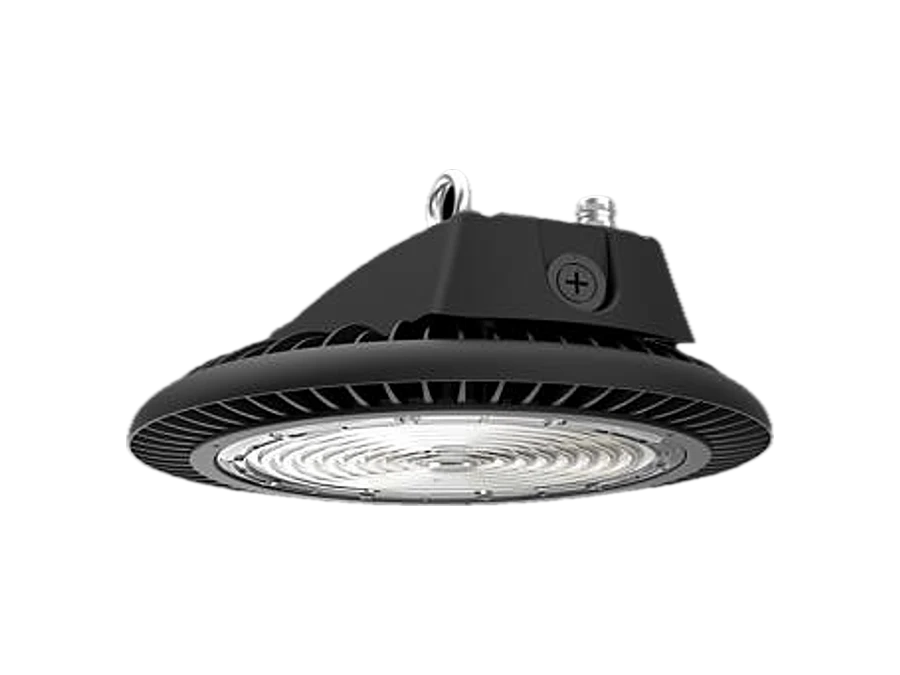
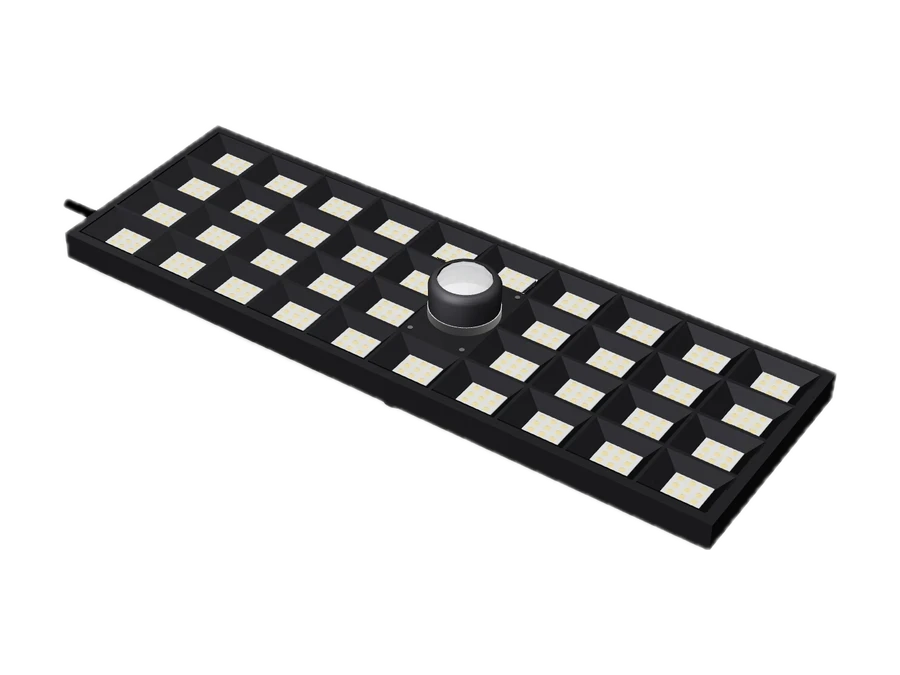
In indoor hockey halls we mostly use the 07v5 ECO, and with special mounting the 07v6, both ball-impact resistant.
- Series 07
07v5 ECO
Halls with robust requirements: riding halls, multi-purpose, tennis and padel halls, storage and multi-purpose halls.
- Colour temperature
- 3000 K, 4000 K, 5000 K
- Power
- 150–300 W
- Weight
- 8.7–9.5 kg
Datasheet as PDF (286 KB) - Series 07
07v6
Riding halls, sports halls, exhibition areas, industrial and commercial halls. Extremely low-glare.
- Colour temperature
- 3000 K, 4000 K, 5000 K
- Power
- 100–200 W
- Weight
- 4.25 kg
Datasheet as PDF (298 KB)
Emergency lighting needed too?
If needed, you can get emergency lighting for your site through our sister brand NOTLUX.
To NOTLUXFrequently asked questions
How many lux does indoor hockey need?
Under DIN EN 12193 it is 300 lx in Class III, 500 lx in Class II and 750 lx in Class I, each with a uniformity of 0.7. The FIH recommends more: 500 lx at 0.7 for training and local club sport, 750 lx at 0.8 for major regional and international matches without television and 1,000 lx at 0.8 with television.
What value should a club plan for?
For school sport and training, the standard with 300 lx is the lower limit and the FIH recommendation of 500 lx the higher target. Anyone who also hosts medium-level competitions reaches 500 lx in Class II anyway. For your division, ask your regional association whether it has its own requirements.
Does the association specify lux values?
The rules of play of the Deutscher Hockey-Bund in the February 2022 version and the rules of play of the Hockeyliga from 2023 give no lux value for indoors. The standard, the FIH recommendation and any requirements of your association are therefore decisive.
How does the indoor hockey hall differ from the hockey pitch?
Outdoors, the standard gives 200 lx for training and regional competitions and 500 lx for national and international competitions. Indoors it is 300, 500 and 750 lx. The uniformity of 0.7 applies in both cases.
How does it differ from the multi-purpose hall?
According to the FIH, indoor hockey is often played in multi-purpose halls, so a dedicated hall is not necessary. What matters is that the lighting is based on the sport with the highest visual demands. In Class III that means 300 lx at 0.7 instead of 200 lx at 0.5 for handball and basketball.
Is the existing hall lighting sufficient?
A measurement or lighting calculation will show. The benchmark is average illuminance and uniformity, not the impression in the room. If the luminaires are being replaced anyway, levels for school sport, training and match day can be planned in at the same time.
Send an enquiry for indoor hockey lighting
Tell us your hall, use and division. We will get back to you with an initial assessment for your project.
Talk directly