Floodlighting at 3000 kelvin: what applies and what it brings
Warm white light of at most 3000 kelvin has less blue content than neutral white light of 4000 K or more. Many municipalities, funding programmes and nature conservation conditions set 3000 K as the upper limit for sports ground floodlighting. The reason given is mostly insect and nature protection. There is currently no nationwide law that prescribes 3000 K.
From Leon Weber, Key Account Manager Sport · As of:
Why 3000 kelvin?
Many nocturnal insects are particularly strongly attracted to short-wave, blue light. Warm white light of 3000 K or less contains less blue.
Municipalities, funding programmes and nature conservation authorities often set 3000 K as the upper limit for outdoor lighting, including sports ground floodlighting. The reason given is mostly insect and nature protection, but not every requirement states this explicitly.
What does the law regulate? § 41a BNatSchG
With the Insektenschutzgesetz (Insect Protection Act) of 2021, § 41a was added to the Bundesnaturschutzgesetz (Federal Nature Conservation Act). It is intended to protect animals and plants from the adverse effects of lighting.
According to the Leibniz Institute of Freshwater Ecology and Inland Fisheries (IGB), however, the provision only comes into force with an ordinance under § 54(4d) and (6b) BNatSchG. The federal government has announced this ordinance as part of the National Biodiversity Strategy by 2027.
For planning today this means: there is no nationwide 3000 K obligation yet. However, requirements can arise from the building permit, state law, the development plan, the nature conservation authority or funding conditions.
Municipalities and funding programmes
In practice the requirement mostly comes from where the system is built or funded. In Germany, the technical annex of the Kommunalrichtlinie (Municipal Guideline) for sports facilities gives a colour temperature of at most 3000 K as a rule, and up to 4000 K in exceptional cases if the sport requires it. Another example is the state of Lower Austria: the appendix to the funding application for LED floodlighting on full-size pitches requires, for competition and training, a colour temperature of at most 3000 K, colour rendering of at least Ra 70 and no upward light emission (ULR 0).
Ask the municipality, the funding body and the lower nature conservation authority before planning. We take the requirements into account from the start.
3000 K or 4000 K: what changes?
Warm white light looks more yellowish, neutral white light cooler. For the standard values of DIN EN 12193, colour temperature is not decisive. What matters are illuminance, uniformity, glare and colour rendering.
Warm white LEDs are somewhat less efficient. At the same illuminance, this can mean more power or an additional floodlight. How much can only be determined by the lighting calculation with the LDT of the 3000 K version.
Colour temperature alone is not enough
The industry points out that colour temperature is only one building block. In its 2022 position paper, the Zentralverband Elektrotechnik- und Digitalindustrie (ZVEI, German Electrical and Digital Industry Association) considers restricting colour temperature to at most 3000 K for insect protection alone to be of little help. Light distribution, brightness and control are more important.
At least as important is where the light falls and how long it burns:
- Light only on the pitch: alignment, suitable optics and glare shields, no light upwards
- Only as much light as necessary: dimming for training, partial lighting of individual areas of the pitch
- Only as long as necessary: switching off after training, time programmes
Which floodlights are available in 3000 K?
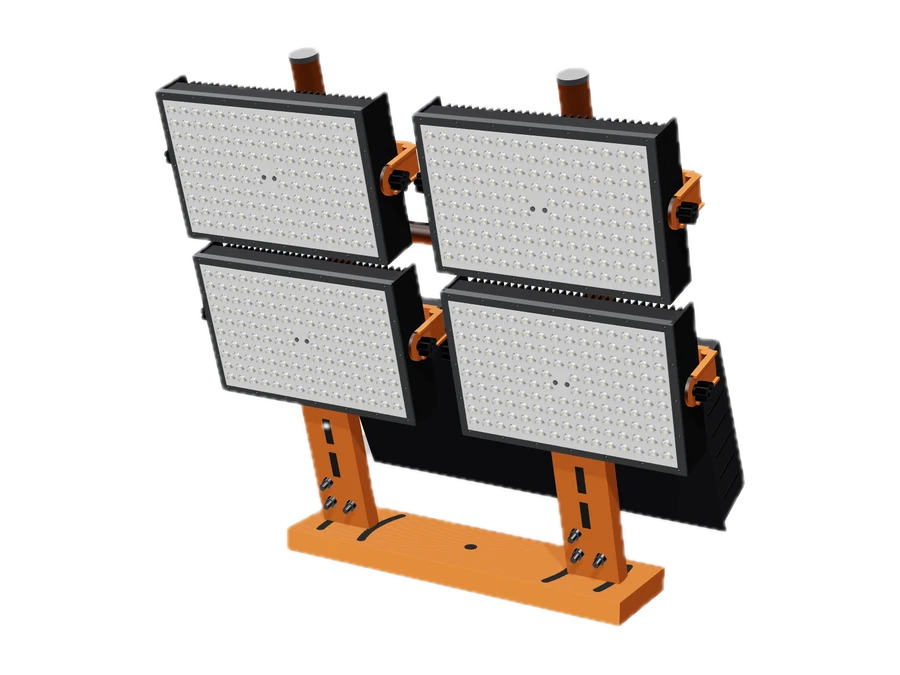
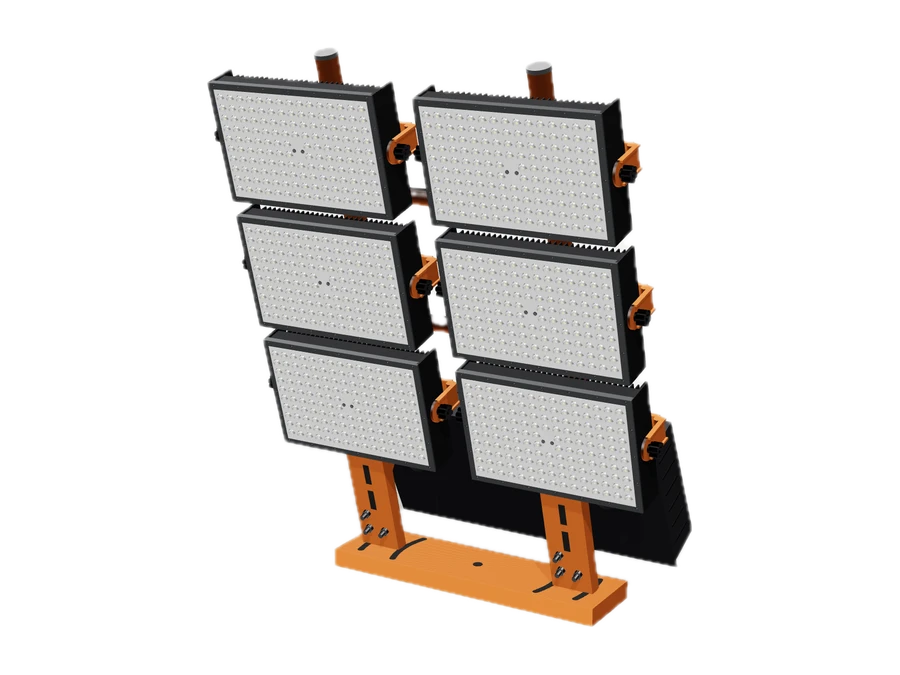
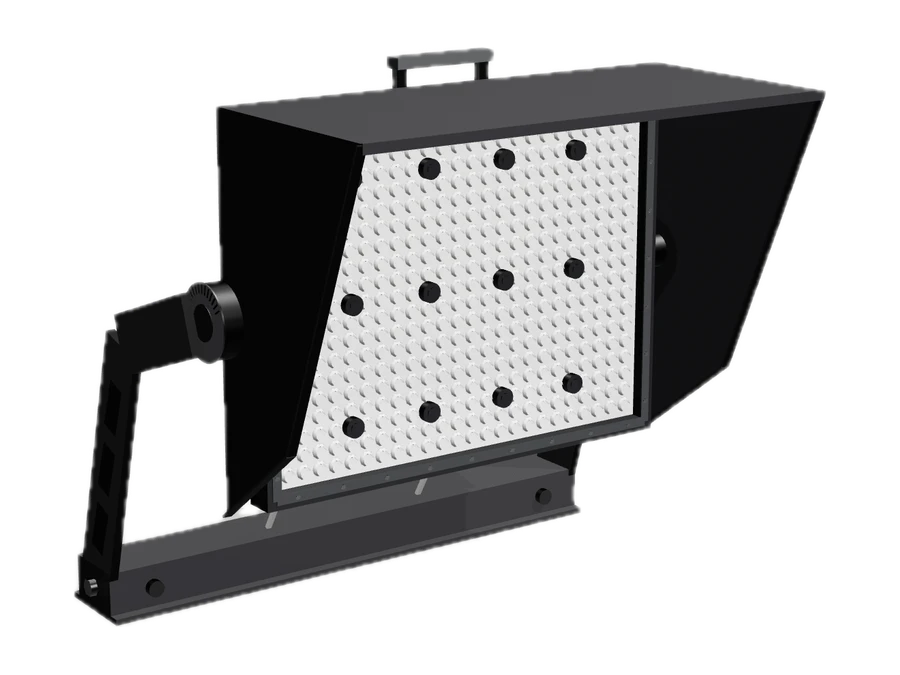
All our products are available in 3000 K: the STL963, STL1443 and STL1500 floodlights, the Series 16 mast luminaire and the 07v5 ECO and 07v6 high-bay luminaires. Competition facilities and stadiums can also be lit in warm white with them.
Floodlights in 3000 K
- Series 12
STL963
Smaller installations and few masts: tennis, padel, training pitches.
- Colour temperature
- 3000 K, 4000 K, 5000 K
- Power
- 960 W
- Weight
- 20 kg
Datasheet as PDF (459 KB) - Series 12
STL1443
Larger pitches with few masts: football, hockey, athletics.
- Colour temperature
- 3000 K, 4000 K, 5000 K
- Power
- 1,440 W
- Weight
- 27.5 kg
Datasheet as PDF (436 KB) - Series 12
STL1500
High requirements from about 500 lx: competition, higher leagues, stadium.
- Colour temperature
- 3000 K, 4000 K, 5000 K
- Power
- 1,500 W
- Weight
- 28 kg
Datasheet as PDF (333 KB)
Frequently asked questions
Is 3000 K mandatory for sports ground floodlighting?
Not nationwide at present. The ordinance on § 41a BNatSchG, which is to set specific requirements, has not yet been issued as things stand. Municipalities, funding programmes, development plans or nature conservation authorities can nevertheless prescribe 3000 K.
Is 3000 K bright enough for competitions?
Yes, colour temperature does not change the standard values. What matters is that illuminance, uniformity and glare meet the values of DIN EN 12193. We check this in the lighting calculation.
Does 3000 K use more electricity?
Warm white LEDs are somewhat less efficient than neutral white ones. At the same illuminance, consumption can therefore be somewhat higher. How much is shown by the lighting calculation with the data of the 3000 K version.
Can a 4000 K system be converted to 3000 K?
With LED floodlights, the floodlight is usually replaced, not just a lamp. We check whether masts and mounting can continue to be used.

Enquire about 3000 K floodlighting
Choose your project. Tell us the on-site requirements; we calculate the installation with the 3000 K variant.
Start enquiryTalk directly


Sources
- Technical annex of the Kommunalrichtlinie of 10 October 2024, section 2.1, sports facilities
- Gesetz zum Schutz der Insektenvielfalt (Insektenschutzgesetz) (Insect Protection Act), version at buzer.de
- Leibniz Institute of Freshwater Ecology and Inland Fisheries (IGB): Lichtverschmutzung (Light pollution)
- State of Lower Austria: appendix to the funding application for LED floodlighting
- ZVEI: position paper on lighting and nature conservation aspects