Reducing floodlight energy costs: LED versus HQI
A floodlight system's energy costs result from connected load in kW, operating hours per year and the electricity price per kWh. Municipal projects report electricity savings of around 40 to over 75% when switching from conventional technology to LED. Dimming and scenes reduce consumption further, because training does not have to run at full load.
From Leon Weber, Key Account Manager Sport · As of:
How to calculate your energy costs
Annual costs = connected load in kW × operating hours per year × electricity price in € per kWh. You need three values from your installation:
- Connected load: number of floodlights × system power per floodlight, for HQI including the ballast
- Operating hours: all hours with the light on, including warm-up
- Electricity price: from your bill, not from an average value
Calculate this once for the current installation and once for the LED installation. The difference is your electricity saving. With a lighting calculation and datasheet, the new connected load can be determined for your pitch.
Warm-up counts: in the practical example of the Stadtwerke Troisdorf, metal halide floodlights need about 20 minutes to reach full brightness and up to 30 minutes to restart after being switched off. LED floodlights light up instantly.
Two examples of the power
The association guide of the football associations of Saxony, Saxony-Anhalt and Thuringia shows the refurbishment of a pitch in lighting class III with six masts: 8 HQI floodlights with 2.2 kW system power each, i.e. 17.6 kW, became 8 LED floodlights with 0.911 kW each, i.e. 7.288 kW. That is around 59% less connected load.
In 2017, the City of Mainz calculated for a sports pitch with a power difference of 8 kW and 500 operating hours per year. That gives 4,000 kWh less per year. Only your own calculation shows which values apply to your installation.
What municipalities report as savings
These are values cited by municipalities and authorities, some planned, some achieved:
- City of Eschweiler: more than 75% on average, 76.82 to 79.17% per installation
- SV Eiche Reichenbrand, Chemnitz, according to klimaschutz.de: around 72%, more than 15,500 kWh per year
- City of Völklingen, 13 sports pitches: over 60%, more than 120,000 kWh per year
- City of Troisdorf, Sportplatz Bergheim: 60%
- City of Speyer, Sportplatz West: 50.68%
- City of Wuppertal, Sportplatz am Nocken: 40 to 50%, with an increase from 120 to around 200 lx
- City of Münster, 28 sports facilities: connected load from 760 to 225 kW, around 70% less
The range is explained by the old installation, the lighting class and whether the new lighting is brighter than the old. The Wuppertal example shows this: the illuminance rose significantly there, and the saving is at the lower end. For funding under the Kommunalrichtlinie, at least 50% greenhouse gas savings must be demonstrated.
Dimming and scenes: less full load
Many old installations only know on and off. The City of Wermelskirchen reports that its old installation often ran unnecessarily at full load. Now 75 lx is enough for training, and full power is enabled for evening training and floodlit matches. In Wuppertal too, dimming to training level brings additional savings.
The association guide also recommends switching and dimming in sections, for example only one half of the pitch or a third of the pitch. For funded installations, the Kommunalrichtlinie requires control suited to use, for example two-stage for training and competition.
Scenes enter the calculation like this: for each scene, apply the actual power and the hours per year and add up the results. Our STL963 and STL1443 floodlights can be dimmed via 0–10 V, optionally by potentiometer, remote control or internet. With the control, you call up scenes such as training or match via app.
Include maintenance
Include maintenance too. The association guide mentions materials and installation for lamp replacement, because cherry pickers are needed for that.
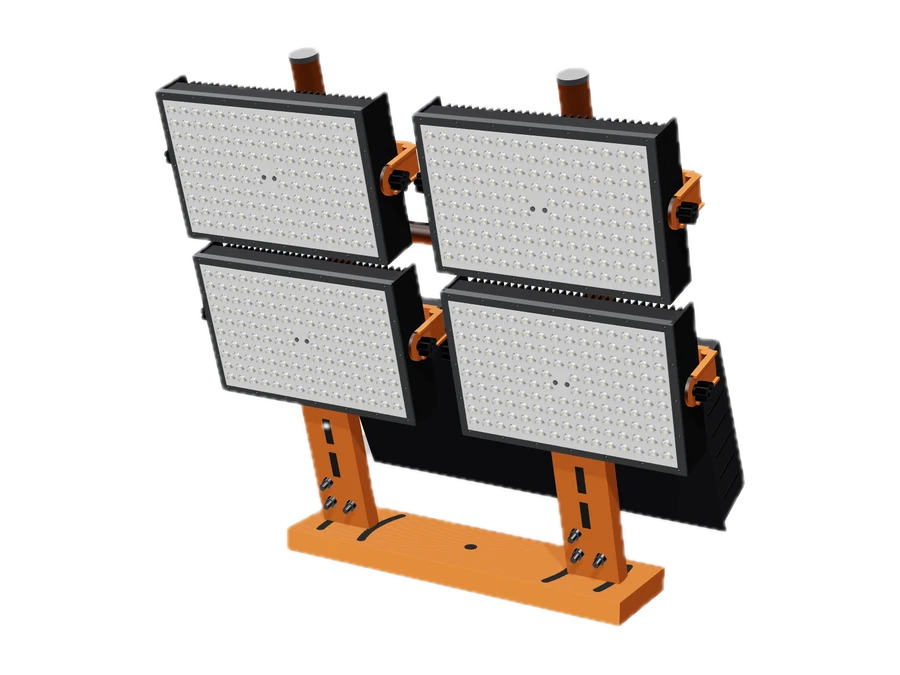
Dimmable LED floodlights
- Series 12
STL963
Smaller installations and few masts: tennis, padel, training pitches.
- Colour temperature
- 3000 K, 4000 K, 5000 K
- Power
- 960 W
- Weight
- 20 kg
Datasheet as PDF (459 KB) - Series 12
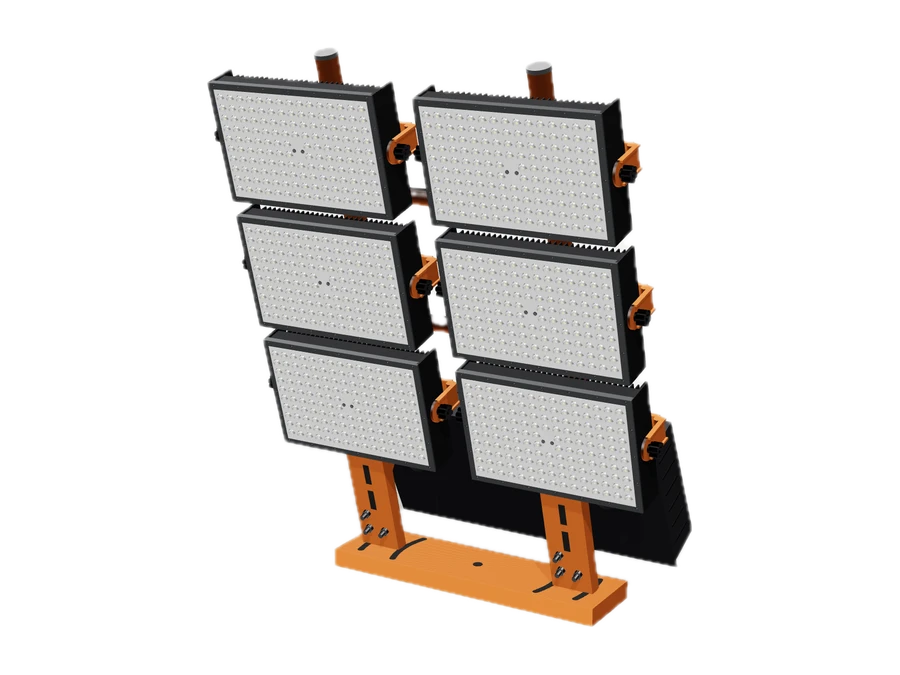
STL1443
Larger pitches with few masts: football, hockey, athletics.
- Colour temperature
- 3000 K, 4000 K, 5000 K
- Power
- 1,440 W
- Weight
- 27.5 kg
Datasheet as PDF (436 KB)
Frequently asked questions
How do I calculate the electricity costs of my floodlight system?
Multiply the connected load in kW by the operating hours per year and the electricity price per kWh. For HQI installations, the ballast is part of the power, in the association guide’s example 2.2 kW instead of 2 kW per floodlight.
How much electricity does LED save compared with HQI?
Municipal projects report values of around 40 to over 75%, for example Wuppertal 40 to 50%, Speyer 50.68%, Völklingen over 60% and Eschweiler over 75%. How much it is for you depends on the old installation, class and use.
Is the retrofit worthwhile only because of electricity costs?
That depends on operating hours and the condition of the old installation. Include maintenance, spare parts and light quality in your calculation.
How much does dimming save with floodlighting?
That depends on how many hours you run at which level. For each scene, calculate power times hours. A general percentage for dimming alone therefore cannot be given.

Calculate the saving for your facility
Tell us the sport, masts, current fittings and your operating hours. We determine the connected load of the LED solution for your calculation.
Start enquiryTalk directly


Sources
- Football associations of Saxony, Saxony-Anhalt, Thuringia: Lighting of football pitches and training areas (2019), pp. 6, 12, 23, 28 f.
- klimaschutz.de (BMUKN): Three sports pitches, three solutions, report of 11 June 2026 (Wermelskirchen, Chemnitz, Völklingen)
- City of Eschweiler: submission 136/20 on the LED conversion of sports pitches
- City of Speyer: refurbishment of the floodlight system at Sportplatz West
- City of Münster: conversion to LED floodlighting, press release of 26 May 2025
- Landessportbund NRW and EnergieAgentur.NRW: Lighting of sports facilities (12/2018), examples Troisdorf and Wuppertal, pp. 14–17
- City of Kyllburg: sports facility fully under LED floodlighting, 4 June 2023
- City of Landsberg am Lech: project information on floodlight system refurbishment
- City of Mainz: reply to enquiry 1695/2017 on the conversion of sports pitch floodlighting, 27 November 2017
- Kommunalrichtlinie of 10 October 2024, No. 4.2.1, and technical annex, section 2.1, sports facilities